

The edible bird nest industry—centered around Swallow (swiftlet) farming—is heralded as a high-value agribusiness across Southeast Asia, especially Indonesia. Although its economic promise is substantial, progress in this sector is often hampered by limited human capital, manifesting as inadequate education, skills, and organized training. This monograph targets this gap by exploring how education and training can be strategically leveraged to elevate the industry’s performance, and know-how practitioners can embed effective methods in their activities.
Drawing on human capital theory (Becker, 1964), which situates education and training as capital inputs with clear returns, this work interprets the literature and field data through a locally grounded lens. Specifically, I examine evidence from Q1 journals on agribusiness training:
Adeyanju et al. (2021)—in Sustainability article—demonstrated that youth agricultural entrepreneurship training significantly boosts farm performance via skill and knowledge acquisition. Hasmin & Yusriadi (2022) used SEM to show agricultural extension quality enhances farmers’ productivity by raising soft‑skills through targeted interventions. Huang (2021) reviewed Taiwan’s “Agriculture 4.0” initiatives and emphasized the vital role of universities in aligning agribusiness education with industry-driven digital modernization
My dissertation adds to this corpus by applying SEM to show how education and training in the swallow bird context drive entrepreneurship and performance. Grounded in real-world cases from Tempe Lake, this book provides practical instruction: from designing modular vocational workshops to implementing mentorship and blended-learning systems—systems proven effective in comparable settings like horticulture.
This book is designed for a wide audience who share a common interest in strengthening human capital within the swallow bird industry—an agribusiness sector that is rapidly growing yet still underdeveloped in terms of structured education and training systems.
At the heart of this book are the thousands of entrepreneurs and swiftlet farmers across Indonesia and Southeast Asia, many of whom have entered the industry through informal learning or trial-and-error experiences. For them, this book offers a practical framework grounded in real field data and validated through Structural Equation Modeling (SEM) analysis. Whether you are a newcomer planning to convert a warehouse into a nesting house or an experienced player aiming to scale production, this book provides step-by-step guidance on how education, training, and technical skills directly influence productivity and profit. You will learn not only what to do, but also why certain strategies are more effective based on empirical findings.
Those involved in agricultural extension, community development, or capacity-building initiatives will find in this book actionable insights for designing and delivering effective training modules. Drawing from mixed-method research, including case studies from Tempe Lake and surrounding districts, the book outlines methods for identifying training needs, creating locally relevant curricula, and facilitating adult learning in low-literacy settings. Readers will also benefit from examples of blended learning models, which combine hands-on demonstrations, peer mentoring, and digital media—especially valuable in post-pandemic outreach scenarios.
Government agencies, vocational schools, and policy think tanks will find here an evidence-based justification for investing in structured human capital programs tailored for the edible bird nest industry. As many regions still lack regulatory frameworks or skill accreditation systems for swallow farming, this book proposes policy pathways and institutional mechanisms to formalize training, standardize competencies, and provide certified education tracks that support inclusive economic growth. References to national skills qualification frameworks (NSQF) and sector-specific accreditation examples are included to assist in policy formulation and curriculum development.
Lastly, for academics, postgraduate students, and development economists, this book offers a valuable case study in applying quantitative tools—particularly SEM—to analyze complex, multi-variable relationships in agribusiness contexts. The research methods section serves as a template for replicating similar studies in other sectors. Moreover, it demonstrates how empirical modeling, when combined with qualitative insights, can lead to more holistic policy and practice recommendations.
In sum, this book is not just a guide—it is a resource for change-makers. Whether your role is on the farm, in the classroom, at a government desk, or in a research lab, the insights presented here aim to equip you with the knowledge and methods to improve lives, livelihoods, and local economies through smart investment in human capital.
In what follows, you will find a blend of theory, empirical data, and on-the-ground insights. Chapters link each step—educational need assessment, curriculum design, skills development, evaluation—to concrete outputs like templates, checklists, and training modules. The goal is to move from understanding why human capital matters, to how it can be systematically built and sustained in this unique industry.
I hope this work serves as a bridge between research and practice, and fosters a generation of skilled, innovative, and resilient entrepreneurs in the Indonesian swallow bird industry.
Dr. Amiruddin, S.H., M.H., M.M.
Banjar, West Java
July 2025
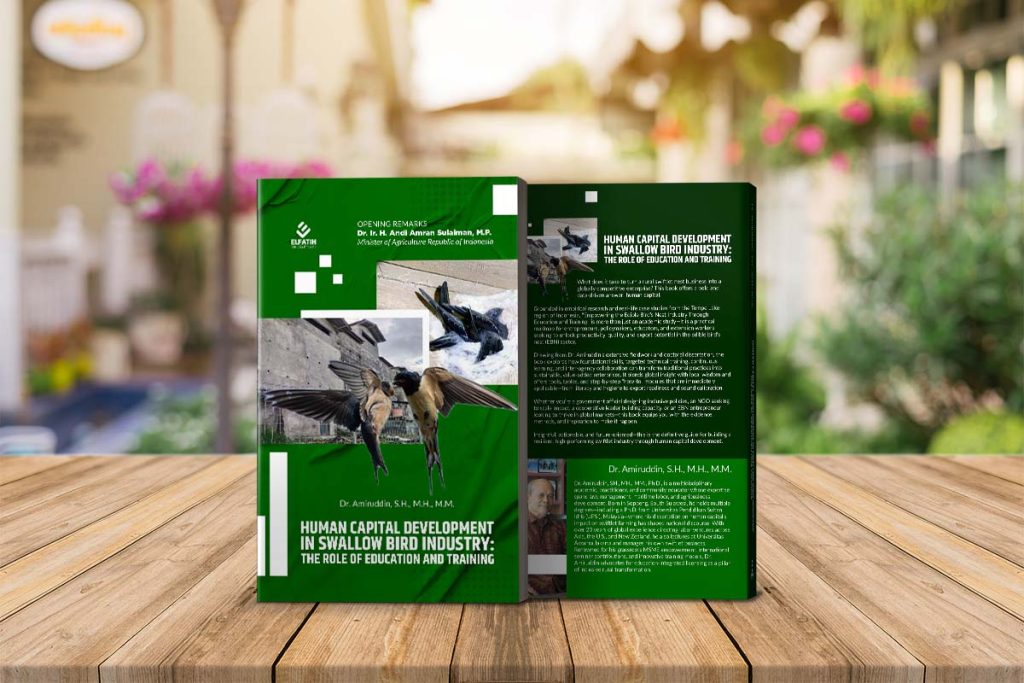
Human Capital Development in Swallow Bird Industry: The Role of Education and Training
Copyright © CV Elfatih Media Insani, 2025
Author:
Dr. Amiruddin, S.H., M.H., M.M.
Editor:
Kuspriyanto
Cover Design, Content Design & Layout:
Elfatih Media Insani Team
Publisher:
CV Elfatih Media Insani (Member of IKAPI)z
xxxiv, 276 pages; 15.5 x 23 cm